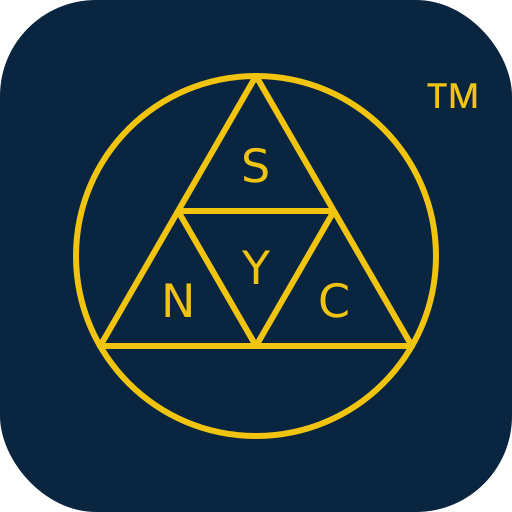
The Method
Five phases. Four principles.
One outcome. One proof.
All of it moving through one roundabout,
with no one directing traffic.
The S.Y.N.C. Method™ is the operating system for executives in the most consequential window of their career.
Where this came from
The method is Western pragmatism and Eastern wisdom, with ideas gathered from well beyond both. It does not work without all of it.
The pragmatism has a record. He was usually one of the top producers wherever he worked, and that was never the most useful thing he did. He kept finding the bottleneck that was costing his organization most, and fixing it. An export control review at the University of Illinois took eight months until he brought it down to one. He carried that approach to Pacific Northwest National Laboratory, then taught it through the Federal Laboratory Consortium, where Department of Energy laboratory technology transfer offices put it to use. An open-source policy framework built at Illinois became the standard at Pacific Northwest National Laboratory and then across Department of Energy laboratories. And when a new business plan at Illinois exposed a backlog of 730 technologies, left from years of commercialization without a dedicated technology transfer office, he built an internship program to triage it, before programs like that were common in the field. The interns did the work the plan had assigned to outside consultants, and saved the university about two million dollars.
The pattern never changed: find the bottleneck, solve it, write down how, then go teach it. That is why the speaking record runs as long as it does. He kept arriving at conferences with something he had already made work.
The wisdom half draws on Japanese, Chinese, Korean, Arabic, Indian, Filipino, Hawaiian, Māori, and Southern African ideas. Frameworks that borrow across cultures usually do so from a distance. The ones at the center of this method were not collected. He lived inside them. He holds a degree in Japanese with a minor in Asian Studies that required Chinese and Korean alongside it. He went to Kyushu at nineteen, to Taiwan at twenty-two to learn Mandarin the same way, married into Japan, and spent more than seven years living there. He advised on Japan’s equivalent of the Bayh-Dole Act. He spent nearly nine years in Doha inside an operation spanning more than sixty nationalities.
Consensus built quietly before the meeting, and a room where independent parties align without a command at the center, are not concepts he read about. They are how the work actually got done, for thirty-five years, before any of it was written down.
He presented the Self-System-Mission™ framework on a TEDx stage in New Cairo in October 2025, more than a year before the book publishes. The ideas were tested in front of an audience first and written down after.
The Roundabout That Changed How I Lead. TEDxEtTagammo, New Cairo, Egypt, October 3, 2025. 100,000+ views.
The green room
John got his first stage role at nine and acted in thirty productions before he was twenty. What stayed with him was not performing. It was watching the marquee names take the credit while the show was actually made by the scriptwriter, the stage manager, the costumer, and whoever was running the lighting board.
He also learned to stand in the green room before curtain and tell whether it would be an A show or a C show. Not from the script. From whether the people in that room were together.
Same cast either way. Same building, same payroll, same seats sold. The difference is alignment, and it costs nothing to produce and everything to lack.
Three roads enter the roundabout, Self, System, Mission, in that order.
You synchronize with yourself before you can read the system. You read the system before you can serve the mission. Skip a road and the roundabout jams.
The Five Phases
Each phase is a Route. Each Route is a sequence of Stops.
- 01
Synchronize
Read the system you have inherited. Move with its momentum, not against it.
- 02
Personalize
Lead from who you actually are, not who you think the role requires you to be.
- 03
Naturalize
Build leadership capacity that holds under pressure without requiring constant conscious effort.
- 04
Communitize
Build the conditions where people do not just collaborate. They belong.
- 05
Democratize
Build legacy as living architecture. What you build keeps building after you are gone.
The Operating Disciplines
Four principles. One outcome. One proof.
Underneath the five phases are four principles, the outcome they produce, and the proof that they are working. Together they form the S.Y.N.C. Canon™: the operating code for alignment that lasts.
See what is actually happening, without the filter of wishful thinking or the comfortable narrative. It is the prerequisite for everything that follows. A leader who cannot see clearly cannot align anything.
Treat every person and every system as an integrated whole rather than a collection of functions. Fixing parts while ignoring the whole is not leadership. It is maintenance.
Imprint runs in two directions at once. It is the pattern a leader's behavior sets in the first six to eighteen months in the chair, and it is the patterns installed in them long before any title. Both are active every day.
The room people have to contribute more than their job description requires without paying a hidden cost for doing it. Where that margin is high, the gap between where people are and what they are capable of becomes the organization's most valuable resource instead of its most inconvenient fact.
The outcome state every phase is working toward. The people who contribute the most are not also the ones who sacrifice the most, and the trajectory of the organization and the trajectories of the people inside it point in the same direction.
Trust is not a principle you implement. It is the proof that everything above it is working. It appears when people experience Truth in how a leader sees the situation, Whole in how they are treated, Imprint in how the leader carries themselves, Cultural Margin in how they are led, and Mutual Prosperity® in where the work is taking them.
The method is what runs underneath the work. What it produces for the people who pay for it is on the engagement pages.
The Book
It is written down.
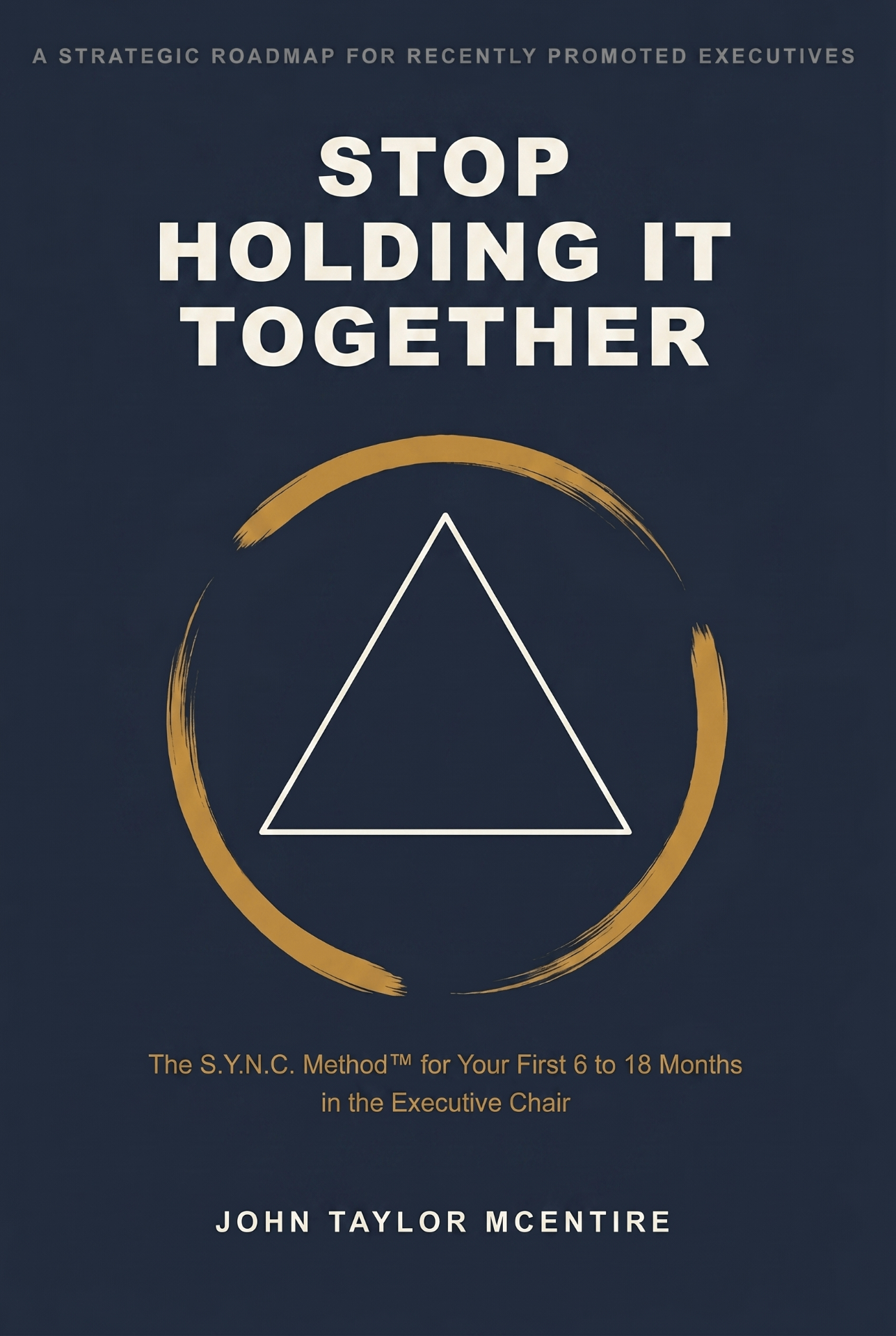
Stop Holding It Together: A Strategic Roadmap for Recently Promoted Executives, with a foreword by Jack Canfield. Releasing January 2027.
It is the clearest way to understand how John thinks before bringing him into your organization, and the book to hand the executive you just placed.
Praise
Praise for Stop Holding It Together
“John embodies what aligned leadership really looks like. Stop Holding It Together reflects the clarity that comes when a leader stops writing the book they think they're supposed to write and instead writes the one they were actually meant to write. It speaks directly to the moment many leaders reach success and quietly realize that alignment now matters more than effort. The S.Y.N.C. Method gives leaders permission to slow down, listen more deeply, and lead from purpose rather than pressure.”
“This is really strong work: thoughtful, grounded, and full of real-world wisdom that only comes from lived experience. John translates complex leadership challenges into practical, honest guidance that leaders can actually use. This book is indispensable for executives stepping into complexity.”
“John doesn't just teach leadership, he lives it. He brings clarity and depth to moments when leadership becomes more internal, and alignment matters as much as execution. Stop Holding It Together reflects a mature integration of personal insight and practical leadership, offering a grounded framework for navigating transition, responsibility, and growth at higher levels. When John speaks, people listen, and more importantly, they lead differently.”
“Stop Holding It Together speaks to leaders who step into greater responsibility and realize that alignment now matters as much as execution. John Taylor McEntire writes with credibility because he has lived the transitions he describes, leading in complex environments where misalignment carries real personal and professional cost. The S.Y.N.C. Method offers a grounded, practical way for executives to align self, system, and mission during moments that define their leadership.”
“John brings structure and clarity to moments when leadership requires more than performance. Stop Holding It Together offers a practical framework for navigating transition, responsibility, and alignment at higher levels of leadership. The S.Y.N.C. Method is thoughtfully sequenced and grounded in real execution.”
“The book Stop Holding It Together offers new leaders a deeply personal guide to successfully manage an organization of diverse people who each have their own emotional blind spots. John inspires readers with his experience of transforming years of 'analyzing and fixing' into a process to heal his old traumas and become an emotionally healthy leader. He addresses every aspect of good leadership, including the toughest: an organization's shifting emotional state.”